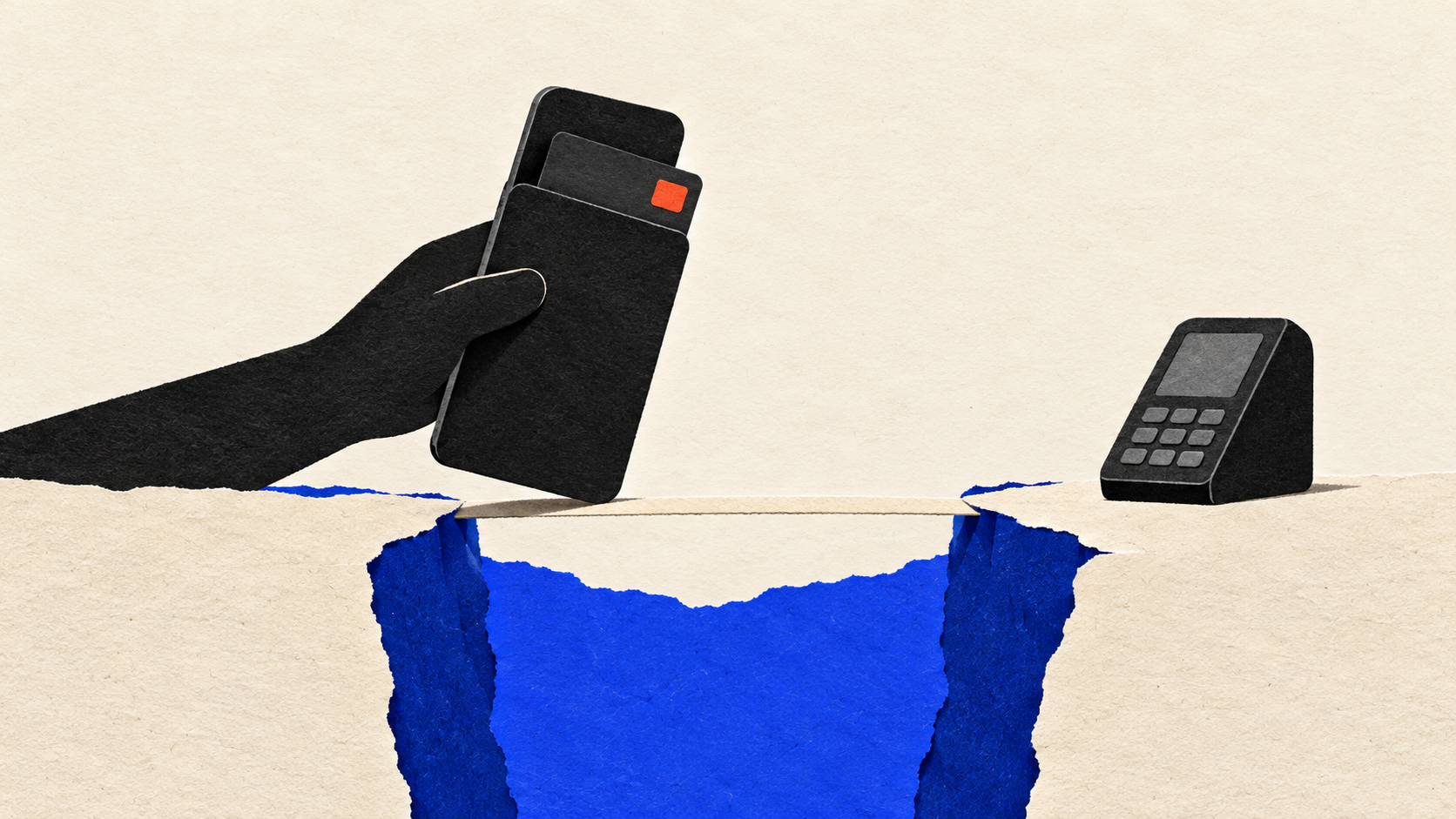
Apple Pay has arrived in India, but the most important launch detail is not the arrival. It is the boundary around it. The service begins with Axis Bank-issued Visa and Mastercard credit cards. It is a new way to use an eligible card on an Apple device—not the arrival of UPI inside Apple Wallet, and not support for every bank or cardholder.
That makes the September 30 launch two stories at once. There is a concrete product people in the supported group can use. There is also an unresolved expansion story: how a service available to one combination of bank, network and card type becomes useful to a much broader audience. A smooth payment can demonstrate the first without answering the second.
We read the complete public transcripts of five recent videos, then checked the launch against Apple's announcement and Juspay's merchant-network statement. The coverage includes a reported coffee-and-flowers payment demonstration, attributed reporting about bank negotiations, and three explanations of the rollout. Those are different kinds of evidence. Five videos do not become five independent confirmations of every claim simply because they come from five channels.
What is available now
Apple's announcement names the supported Axis credit cards, in-store contactless payments and participating app and web checkouts. It lists iPhone XR or later with iOS 18 or later, and Apple Watch Series 6 or later with watchOS 11, paired with a compatible iPhone. Eligible iPads are included; Mac support is described as forthcoming. These are announced requirements, not our test results. Apple's India launch announcement ↗
Mint's recap contributes the device requirements and the continuation of existing card rewards. Firstpost makes the card-versus-UPI distinction explicit and explains that adding a card may require bank approval. Business Standard separates that setup stage from checkout authentication and warns that overseas charges remain subject to the underlying bank. None establishes that an unsupported card becomes eligible merely because a phone can display Wallet.
For readers, the useful question is therefore specific: does the launch change a payment you can actually make? A supported device, a supported card and an appropriate checkout have to meet in the same transaction. An announcement about a country is not a substitute for checking those individual conditions. The answer can be yes for one person and no for another without either person contradicting the launch.
A demonstration, with a boundary
NDTV's reporter describes paying for coffee after Face ID authentication, then completing a second purchase for flowers. That is the strongest firsthand contribution in this source set. It shows reported use at two merchants. It does not measure nationwide acceptance, comparative checkout speed, failed-payment rates or long-term reliability. YTTN did not conduct those transactions. NDTV's hands-on launch report ↗
The distinction is not a reason to dismiss a demonstration. It is a reason to ask it the right question. A launch recap tells you what a company says is available. A demonstration shows how a particular use was reported to work. An independent comparison would require a defined alternative and repeated observations. These forms of coverage become more useful when they complement one another instead of borrowing one another's authority.
The launch is also easier to understand when viewed from the shop rather than the phone. A customer wants to finish a purchase. The interesting test is not whether a payment method looks elegant in isolation, but whether it fits the transaction in front of them. An additional option is valuable when it removes a real inconvenience; it is less consequential when it merely duplicates a routine that already works well.
Why the next bank matters
CNN-News18 reports, citing its sources, that talks with other banks continue and that transaction fees are a sticking point. It does not supply an agreed rate or an expansion date. The outlet's contribution is the attributed account of an obstacle, not proof that a deal is imminent. Treating negotiations as a completed partnership would erase the very uncertainty that makes them newsworthy. CNN-News18's launch and negotiations report ↗
A second issuer would be a meaningful development because it would alter the entry condition, not merely add another promotional message. Yet bank expansion, card-type expansion and merchant integration would each answer a different question. One should not stand in for the others. A larger list of places to pay cannot help a reader whose card remains unsupported; another eligible card does not establish that a particular online store offers the option.
This is the central tension of the launch: Apple can show a payment experience before the surrounding access becomes broad. The rollout should be judged neither as universal transformation nor as meaningless because it starts narrowly. The harder question comes after the successful tap: what would make this an everyday habit rather than another payment option people rarely need?