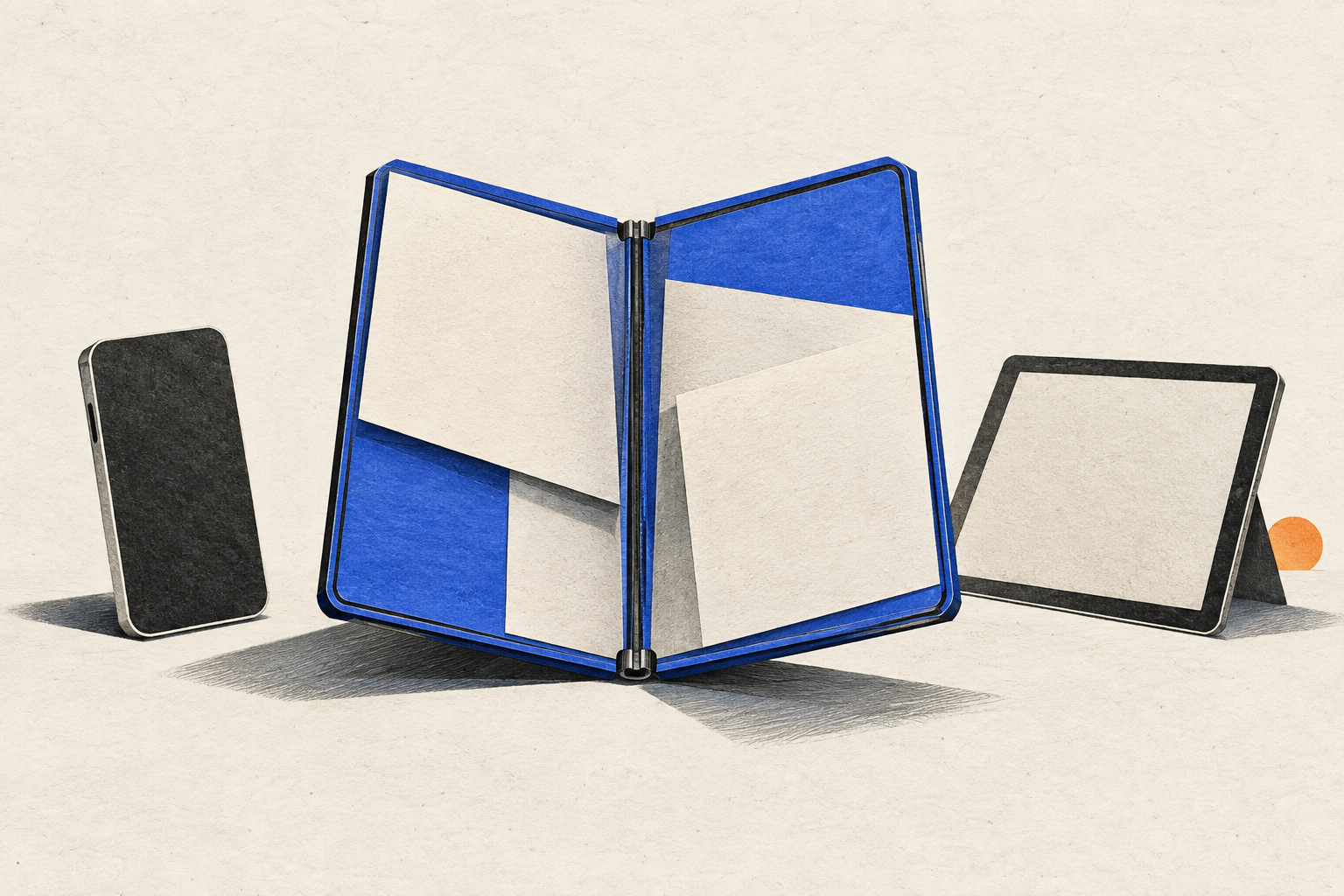
The useful question about Apple's iPhone Duo is no longer whether a folding iPhone looks impressive. It is what you would stop doing on another device if you owned one. Across five recent video assessments, that question separates the strongest case for the Duo from the excitement surrounding it. A bigger workspace can be genuinely valuable. It does not automatically make a better everyday phone, a better camera, or a cheaper way to own the devices you already use.
The disagreement is revealing. AppleTrack's comparison leans toward the conventional Pro. Matt Talks Tech makes an enthusiastic case for the foldable's extra possibilities. Marques Brownlee examines the relationship between the Duo and the iPad mini, while Dayo Aworunse compares the purchase with the combined role of a premium phone and a compact tablet. CTV News brings the discussion back to the price confronting a mainstream Canadian buyer. These are different buying arguments, not five independent laboratory tests.
That distinction matters before spending flagship money. We read the complete public transcripts of all five videos, published within the preceding 48 hours, and checked key launch details against Apple's announcement. YouTube Tech News has not tested the Duo. This is an analysis of the early evidence and competing assessments, not a hands-on review or a verdict on long-term reliability.
What Apple has actually announced
Apple lists a US starting price of $1,999 and availability from October 23. The Duo pairs a 5.4-inch outer display with a 7.6-inch inner display, supports two-app Split View and uses Touch ID. Apple describes a surface treatment that minimizes the crease's visibility; it does not say the crease ceases to exist. USB-C Apple Pencil support is promised later this year. Those are announced specifications and timing, not results from our testing. Apple's iPhone Duo announcement ↗
Start with the timing rather than the specification list. A purchase made for an announced future feature rests on a different kind of evidence from a purchase made for something already demonstrated. Readers who need handwriting or drawing support should check its actual availability before ordering. Readers who need a dependable camera or a particular app workflow should ask for evidence of that exact task, not assume the most unusual model must also be the most capable in every respect.
A phone that becomes a workspace
Brownlee's discussion is useful because it asks where the product belongs. His interview with Craig Federighi considers the relationship with the iPad mini, and his own observations emphasize how software moves between the two screen arrangements. The important idea is continuity: a task should become easier when the phone opens, without forcing the person using it to reconstruct what they were doing. That is a more demanding standard than simply making an interface larger.
For a reader, the test might be a document beside a conversation. For someone coordinating work, it might be reference material beside a message that needs an accurate reply. These are examples of tasks to try, not claims that we have verified every app combination. The benefit depends on whether the extra context removes friction. If opening the device only creates another way to browse the same single feed, the case for paying more becomes much harder to make.
Matt's positive assessment puts multitasking and flexible positioning at the center of the appeal. Aworunse, meanwhile, focuses on the demonstrated transitions and placement of controls. He explicitly says he is not at Apple's hands-on event and uses his existing Samsung foldable while explaining his preferences. His contribution is comparative reasoning about how a foldable should behave, not direct experience with the Duo. Confusing those two things would turn an opinion into evidence it cannot supply.
Why the Pro still has a strong argument
AppleTrack's preference for the Pro is a useful counterweight to the assumption that the most expensive design wins. Its comparison emphasizes camera specialization and the compromises of a folding form. Matt and Aworunse also acknowledge camera trade-offs even while liking the Duo. The common thread is not that the foldable takes bad pictures; none of these discussions establishes that conclusion. It is that a larger display and a more specialized camera system solve different problems.
A parent trying to photograph action at a distance, a creator with a particular capture workflow, and a reader who wants more space for documents may reasonably make different choices. The relevant comparison is the result each person needs, not the prestige of the product name. A feature you use every day can outweigh a dramatic capability you rarely open. Conversely, someone constantly switching between reference material and a conversation may value the larger workspace more than an extra camera option.
The physical question deserves the same attention. Thinness when open is not the same experience as carrying a closed foldable. Aworunse describes the opened device as a two-handed proposition. Brownlee notes that much of his own foldable use happens on the outside screen, an anecdote rather than a survey of users. Together, those observations suggest a practical question for a shop demonstration: is the closed phone comfortable enough for the many moments when unfolding it would be unnecessary?
This is where the most persuasive argument for the Duo becomes more complicated. Comparing it with the combined job of a phone and a tablet can make the premium seem reasonable. But owning one flexible device and replacing two existing devices are not the same thing. Whether the arithmetic works depends on a part of the buying decision that a launch demonstration cannot answer.